Deep Cycle Batteries: Are they Different?
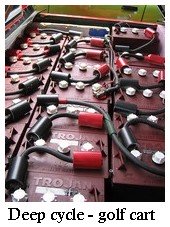
Are deep cycle batteries different than regular automotive batteries? I get asked this question a lot.
"I'm converting an electric car. I see that the "traction" or deep cycle batteries for EVs are pretty expensive, while the DieHards at my local auto parts store are relatively cheap...and they're both lead-acid auto batteries, I see. So, can I save myself a pile of cash by putting those auto batteries in my electric car?"
Answer: No, because not all "lead acid" batteries are the same.
It's true that one battery looks a lot like any other battery, and they take up just about the same amount of space in your battery compartment (depending!), and they both make use of lead-acid chemistry to store electrical power. But that's where the similarity ends! Let's talk a little about the differences.
Deep cycle batteries vs. (SLI) batteries
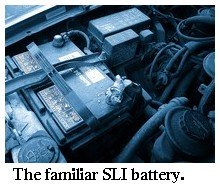
Gas-gobblers have cranking automotive batteries, called SLI for Starting, Lighting, and Ignition, and is designed to deliver a lot of juice at once. It is intended to give up about 5% of its charge before charging back up again off the alternator. The electrolyte plates inside the SLI battery look like something like a large wad of foil which delivers a lot of surface area for the weight, but it's delicate.
The ones you need for an electric car are deep cycle batteries, meaning they don't have any objection to being drained down to 20% of their full charge, and then recharged...over and over and over again. The electrolyte plates inside deep-cycle batteries are often solid metal, heavy but sturdy.
If you put a bank of SLIs in your Xebra thinking you'll save yourself some money, you'll put them under extraordinary strain; that happy wad of electrolyte foil will soon be powder sediment resting on the bottom of Lake DieHard...
...and you'll be WALKING.
Four basic categories of lead acid deep-cycle batteries
- Industrial deep cycle batteries that are not designed to be moved.
These aren't going into your electric car; all the jostling and jolting will kill them prematurely. They're designed to store large amounts of energy (for instance, if you've got solar panels on the roof of your house, you'll need a group of these). An example of the industrial deep-cycle battery is the Concorde AGM Sun Xtender.
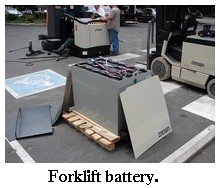
They might not work for the EV, but they're just what you want for your solar charging system at home! - Large industrial deep cycle batteries that ARE designed to be moved (like forklift or floor-sweeper batteries).
Sturdy, but heavy. They offer long-term power for big electric gizmos and often have battery names beginning in FL for forklift or FS for floorsweeper. It's not unheard of for these to make their way into an electric car, but they're generally too big and heavy to be fleet of foot. - Marine "deep cycle" batteries.
I put "deep cycle" in quotes because they're not strictly deep cycle batteries, but rather a hybrid type battery that doesn't mind being deep cycled. These are sometimes used in electric cars, and they're certainly better than ignition-type batteries, but overall, they're expensive per-cycle and in practice don't last as long as the next type... - "Deep cycle" batteries often used in golf carts.
These are the batteries most often found in electric cars and electric car conversions.
HYBRID Batteries?
When I say golf cart and marine batteries are "hybrid-type batteries", I'm talking about the dual battery "personality" of being tolerant of deep cycling but light enough for a mobile application like a boat or a car.I'm not talking about the kind of batteries that you find in a hybrid car! Those are high-power (not high-capacity) NiMH batteries, and not suitable for an electric car, really. They don't appreciate being deep cycled too much. Sorry about the word "hybrid" for the golf-cart batteries - I agree, it's confusing!
There are now over 3500 entries in the EV Photo Album, and of all these electric cars, tractors, bikes, and motorcycles that people have bought or converted, the most common EV battery type is the 6 volt flooded lead-acid deep-cycle golf cart battery made by Trojan.
These golf cart batteries are also a hybrid-type traction battery, but have a longer cycle life (number of times you can drain it and charge it before it dies) than marine batteries.
Chances are, this is the type you'll be using, too.
A big thank you to:
How batteries work - a primer.
Back to Electric Car Batteries: Lead or Lithium?

|

|
Recent Articles


-
Electric Car Conversion Using E-Golf Power Train
Mar 06, 20 05:30 PM
 I own a '19 VW E-golf and would love to transplant the electric powertrain into an old beetle or possibly a Thing (if I can find one cheap enough). Would
 -
𝐓𝐰𝐨 S𝐢𝐠𝐧𝐢𝐟𝐢𝐜𝐚𝐧𝐭 𝐕𝐞𝐡𝐢𝐜𝐥𝐞𝐬 L𝐞𝐚𝐯𝐢𝐧𝐠 𝐭𝐡𝐞 𝐑𝐨𝐮𝐭𝐞 𝟔𝟔 𝐄𝐥𝐞𝐜𝐭𝐫𝐢𝐜 𝐕𝐞𝐡𝐢𝐜𝐥𝐞 𝐌𝐮𝐬𝐞𝐮𝐦
Nov 11, 19 09:51 PM
On this upcoming Saturday, November 9th, a transport truck and trailer will roll into Kingman, Arizona from Los Angeles, California to pickup our very rare circa 1959-1960 Henney Kilowatt with only 40… -
Electric Car Facts and FAQ
Nov 07, 19 04:21 PM
 Electric car facts and frequently asked questions from the e-mail bag. There's no such thing as a dumb question!